
Graphical Abstracts
This gallery showcases some graphical abstracts I realized. Designed for scientific articles or reviews papers to highlight key findings at a glance, or for your website to summarize your research lines, they allow to distill complex research into clear, impactful illustrations (click on the thumbnails to enlarge the pictures).
Abstract #1: mRNA processing steps
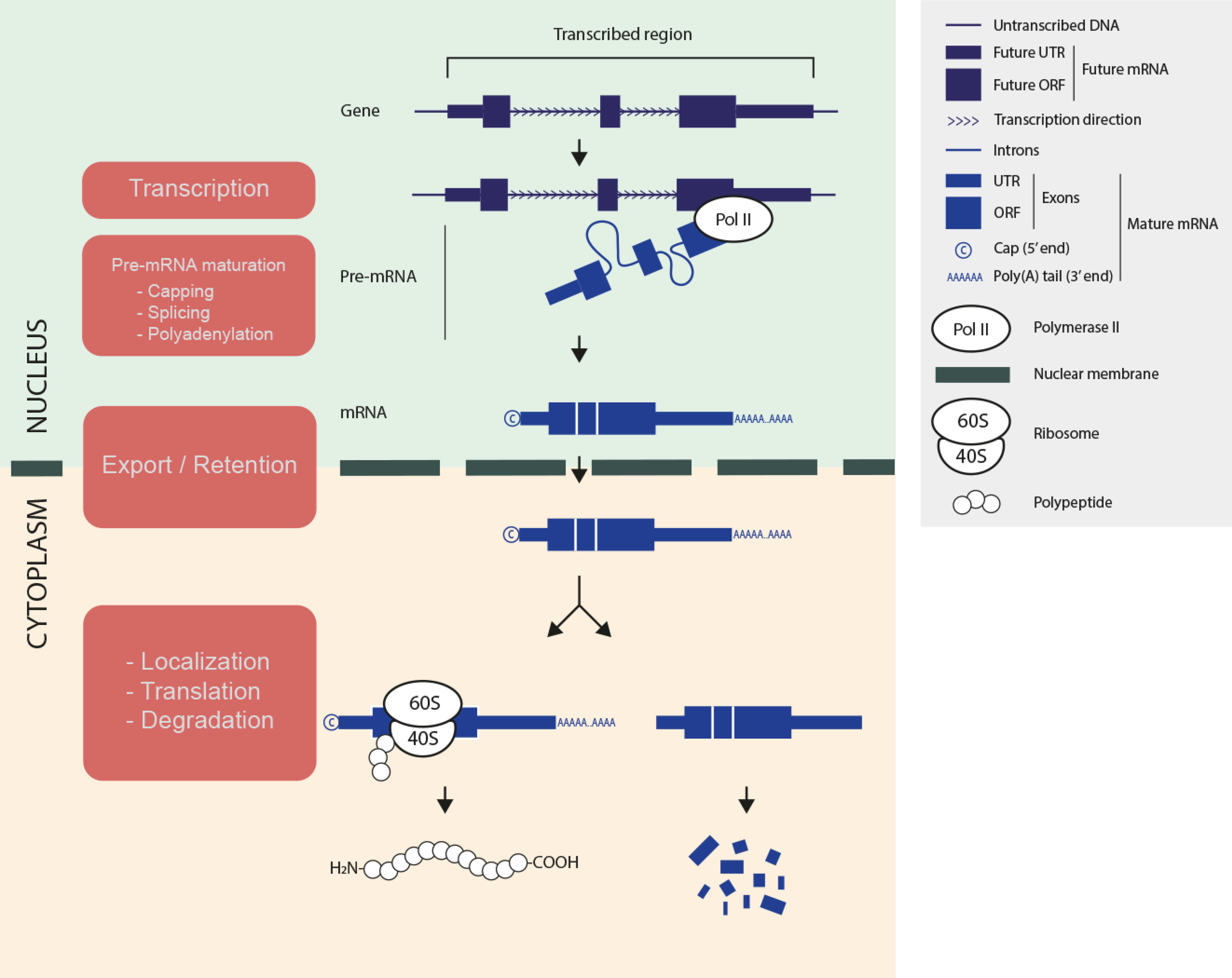
This cartoon depicts the differents steps occuring after an mRNA’s transcription.
During transcription in the nucleus, pre-mRNAs undergo three key steps: a 5′ capping (protecting the molecules from exonucleases and essential for the cap-dependent translation), a 3′ poly(A)-tailing (confering stability to the mRNAs) and a splicing step (modulating its exon composition). Each of those steps can be subjected to regulations affecting mRNAs both quantitatively and qualitatively.
Mature mRNAs are then exported in the cytoplasm, where ribosomes translate them into proteins. Here again, various regulations can occur, from specific localisations in specific cytoplasmic compartments to translatability efficiency and stability adjustments.
Program used:
Adobe Illustrator
Abstract #2: mRNA translation steps
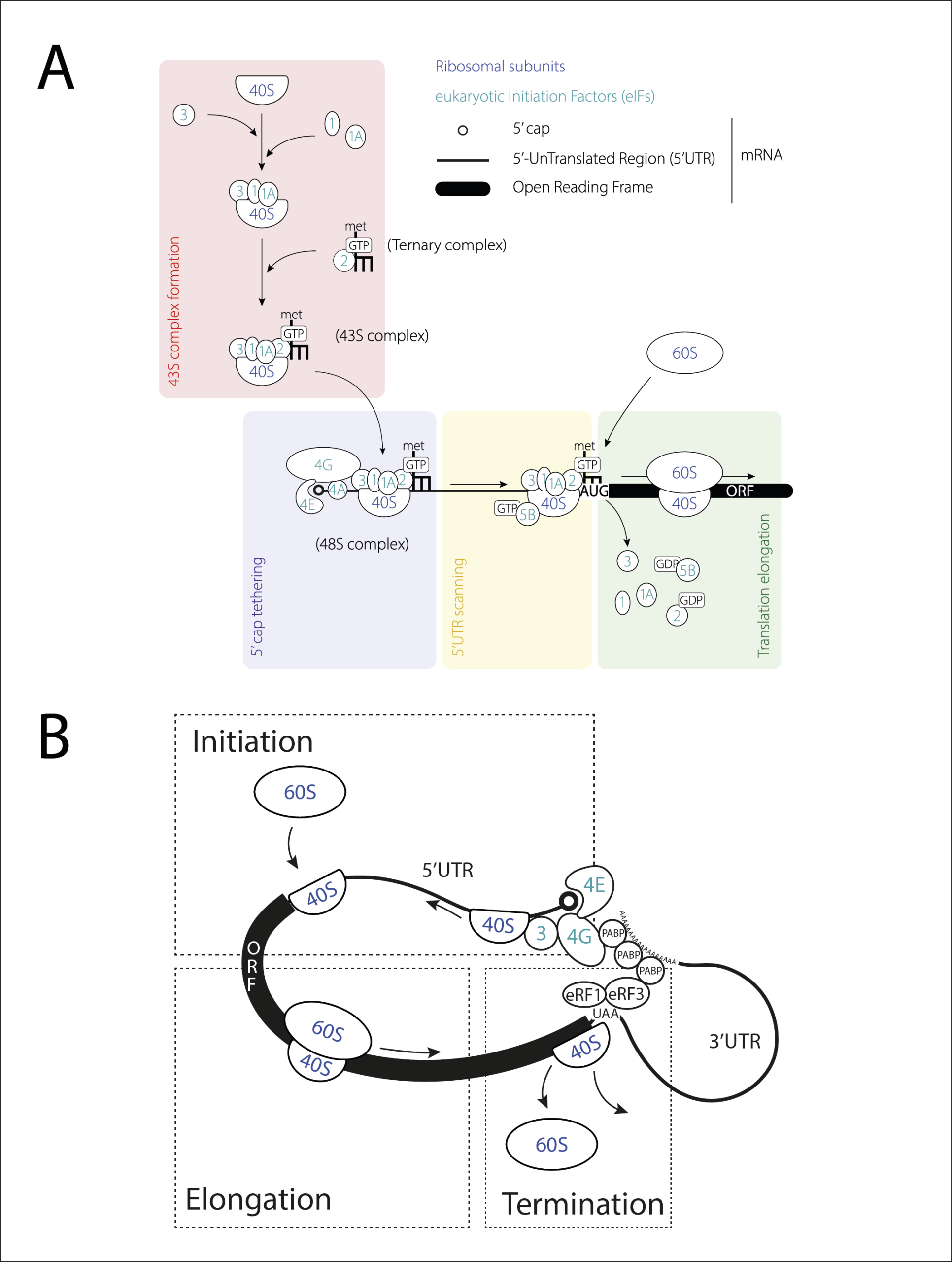
This visual explains how the translation machinery operates during cap-dependent translation in eukayotes:
A. Translation initiation complex assembly: eIF4F complex (composed of eIF4A, eIF4E and eIF4G) is bound to the cap.Two additional complexes are formed: one comprising eIF3 et the ribosomal 40S subunit, and one ‘’ternary complex’’ composed of eIF2, GTP and methionine tRNA. The association between eIF3, the 40S subunit and the ternary complex generates the 43S pre-initiation complex, which is tethered to the cap through eIF3 and eIF4G interaction. Following cap tethering, the 43S complex scans the mRNA 5’UTR until it reaches an AUG start codon and forms the 48S pre-initiation complex. The initiation factors then leave the 40S subunit, allowing the recruitment of the 60S ribosomal subunit. The functional ribosome can proceed to translation elongation.
B. Closed-loop hypothesis: mRNA poly(A) tails are often associated with an increase in translation efficiency. The closed-loop hypothesis proposes that poly(A) tails enhance translation initiation by bringing together the initiation and termination translation sites (through eIF4G, PABP and eRF3 interactions) which would enable eIF4F recycling for further rounds of translation.
Program used:
Adobe Illustrator
Animated version of mRNA translation initiation:
Here is a small animation showing the different steps involved in the cap-dependent mRNA translation initiation (muted version on the right).
Want to view the full version (with sound)?…Watch the original version, with proteins in sync with the soundtrack.
Program used:
Adobe Illustrator
Adobe After Effects